

Enterprise brands are expected to deliver video content more frequently, across markets, and in a variety of formats. However, delivering at this scale via a traditional video production workflow means sacrificing either quality or time, two things enterprise brands can not afford to waste. To meet growing demands at matched quality, brands need a new solution: AI video production.
AI video production is a modern creative workflow in which humans use AI tools to efficiently produce videos at scale. The strategic thinking of a creative team that quality work depends on is not replaced, but rather boosted by AI; think rapid-fire brainstorming sessions, faster iteration, and costs cut in half across our recent hybrid-production projects. In this article, we’ll give a practical overview of how AI production influences brand storytelling, including its benefits, applications and risks, as well as how brands can choose the right AI video production company to partner with.
What is AI video production and why does it matter for brands?
AI video production is a production model in which creatives use generative and assistive AI tools to support them with tasks across the video production pipeline. This can include fast and dynamic concepting via brainstorming tools like Adobe Firefly’s Boards; scripting, versioning and editing support through generative AI platforms like LTX Studio or Google Veo; and instant localization with help from translation tools like Synthesia and ElevenLabs. For enterprise brands, AI-assisted production means scaling up, shortening campaign cycles and reducing budgets – but campaigns aren’t all about speed. Video output needs to be credible and consistently on-brand, elements that only humans can guarantee. This is what separates AI-generated video from AI-assisted video production, as the latter provides strategy on top of efficiency, ensuring that output is legally compliant, representative of a brand’s image, and deeply connected to its message.
This matters for brands because AI-assisted video production provides all of AI’s benefits: speed, scale and affordability, without sacrificing quality or damaging trust.
The core benefits of AI video production for enterprise brands
AI video production benefits enterprise brands in two main ways: faster ideation, iteration and turnaround time whilst maintaining the same level of quality, and cost-efficient scalable content options, such as localization, personalisation and format variation.
How AI reduces production timelines
AI reduces production timelines by automating tasks and redirecting focus to planning and oversight. At the ideation stage, AI video production companies can visualise ideas instantly and check with clients if their vision is matched, moving into the production stage sooner. During post-production, creatives can use AI to automate time-consuming tasks such as masking and captioning, instead using their expertise to direct and review output. After review, reshoots that would have previously required rescheduling, rehiring, and planning against inconsistent variables like the weather can now be retaken or extended by generative AI in just a couple of clicks. Finally, when testing, AI can quickly generate variants; hooks, thumbnails and platform-specific cuts, iterating on output and improving content faster.
Scaling video content across multiple markets
AI video production helps brands scale across markets, platforms and at a personalised level. localization and translation tools can generate subtitles instantly, translate an actor’s voice in over 160 languages, and even lip sync their mouth movements to the new audio. This ensures consistent and professional messaging for your entire audience – no matter the location. Multi-platform campaigns that plan for content variation can further reduce costs with AI tools, rapidly adapting content to fit different social platforms, as well as both internal and B2B audiences, all whilst maintaining brand identity. However, AI shouldn’t do all the heavy lifting here, as over-versioning will soon lose focus and clarity.
| Benefit | What AI changes | Brand storytelling value | Guardrail |
|---|---|---|---|
| Speed | Faster draft, edit, and version cycles | More timely campaign stories | Senior creative sign-off |
| Scale | More cutdowns, markets, and formats | Consistent story across touchpoints | Message architecture |
| Cost control | Less manual repeat work | Budget can shift to higher-value creative work | Scope discipline |
| localization | Faster subtitles, dubbing, and adaptation | Stories travel across markets | Local review |
| Iteration | More creative variants | Better fit to audience context | Performance data, not guesswork |
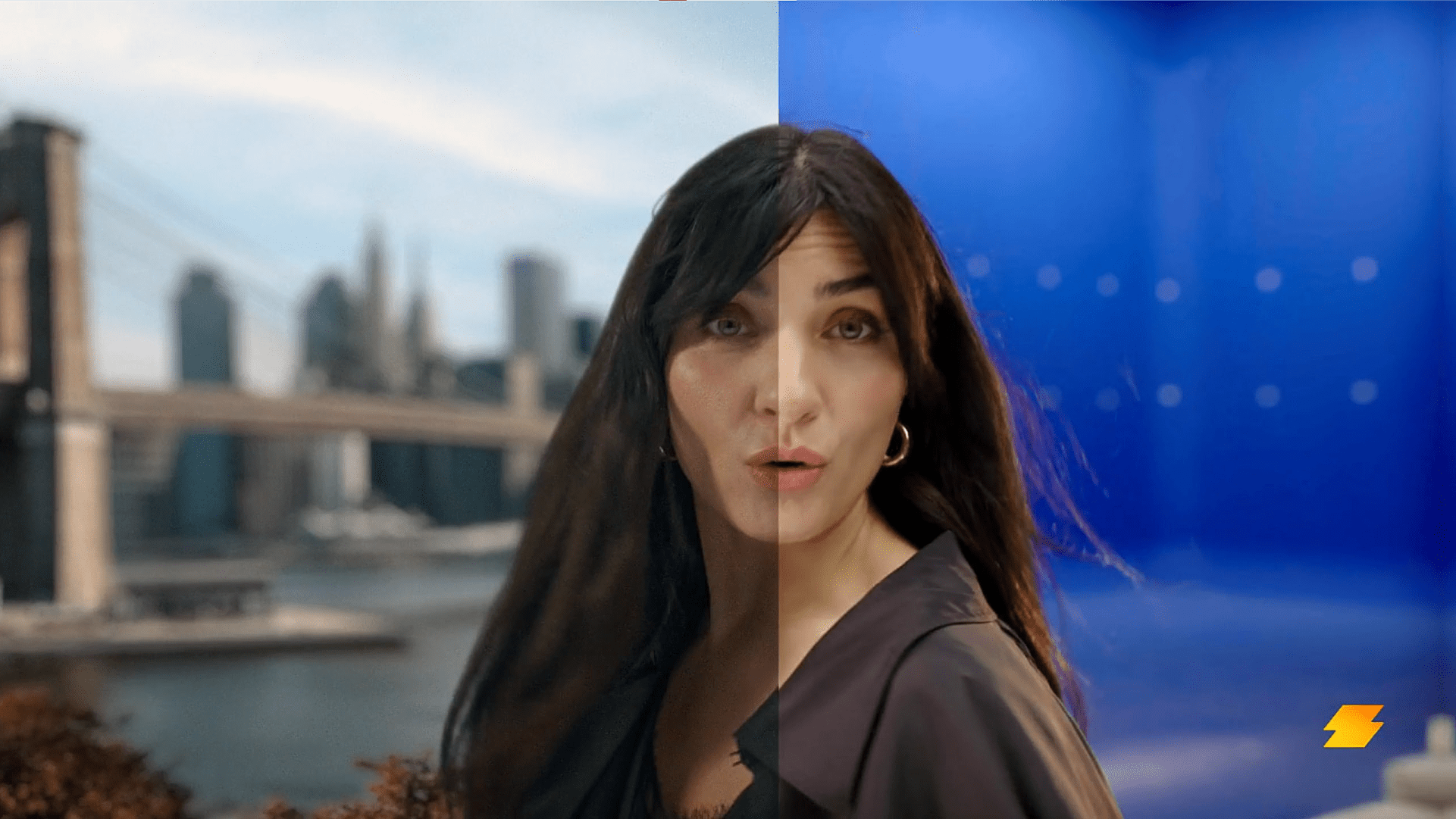
AI video production techniques changing brand content
With all the buzz around AI it can be easy to forget that, as a tool, it works best when used selectively.
At Synima, we use the following AI video production techniques to amplify brand content:
• Iterative storyboard development. We use generative AI to visualise ideas while they are fresh. We can experiment with variants and present near-polished visuals of the final output to clients, ensuring our vision aligns before production.
• Intelligent scene selection. There’s no need to comb through hours of footage, AI tools can automatically extract highlights for social or short-form content.
• Automated video editing. AI can assist with time-consuming tasks such as resizing and masking, getting the bulk of the work done and freeing up time for refinement.
• Predictive analytics. AI can detect patterns and accurately forecast how content will perform across metrics like retention, watch-through and platform performance.
• Multilingual support. We reach global audiences by pairing localized variants of video with AI translation tools. These provide subtitles and voice synthesis instantly, and when paired with a deep understanding of a client’s audience, help strengthen connection.
How AI supports creative storytelling without losing the human touch
AI does not replace craft; instead, it accelerates it, and supports the creation of visuals that would’ve otherwise been too implausible to film traditionally.
Resonant storytelling that stays with audiences relies on the choices of humans. AI can increase the amount of creative options explored, handle repetitive tasks, and expand a video’s reach, but for a story to connect with people, there needs to be directors, strategists and creatives shaping it.
| Production stage | AI-assisted use | Human responsibility |
|---|---|---|
| Strategy | Audience and message exploration | Decide the story and campaign purpose |
| Concept | Moodboards, prompts, references, pre-vis | Choose the creative route |
| Script | Drafting, alternatives, edits | Control tone, claim accuracy, narrative |
| Production | Synthetic assets, support visuals, avatars | Direct performance and brand fit |
| Post | Edit support, captions, dubbing, variants | Final edit, quality, compliance |
| Measurement | Variant and retention analysis | Decide what to change next |
Real-world applications: how leading enterprises use AI video production
Leading enterprises are already using AI-powered video production to create ambitious visuals and large-scale campaigns. Here are a couple real-world examples:
Social media commercials. Global spice brand Shan Foods’ Diwali campaign was shot traditionally, but production started with an AI-assisted storyboard. By turning our hand drawn visuals into a polished, near production-ready version, we could ensure that our vision was accurate to the client’s expectations. With a total of 3.8 million unique viewers across platforms and a post-engagement rate of 14.3%, this hybrid AI approach was a great success.
Awareness campaigns. UK charity Nacoa’s awareness video for their children’s helpline needed to provide perspective, be sensitive, and connect. With a reduced budget and just one week to deliver, we paired traditional 3D animation with AI-generated textures and environments, intentionally designing the space and framing each shot to deliver the impact the film needed.
Success metrics for AI-powered video campaigns
The right production partner for you will likely use AI to predict how a campaign will perform before release to maximise potential, and also offer long-term post-delivery support. Metrics such as click-through rate, average watch time, conversion tracking, brand sentiment, message recall and training completion will reveal what’s working and what needs improving.
Metrics can also be used to measure how the implementation of an AI tool compares to its traditional counterpart. If an AI tool bills via a credits system, for example, then the volume of usable creative outputs is a necessary metric to measure. The same sentiment applies for time to localization and cost per variant, both of which will reveal whether the use of AI is helping or hindering the production process.
Like any campaign, AI-powered videos should be measured for performance.
Choosing the right AI video production partner for your brand
When choosing an AI video production partner, look for hybrid capability (see our comparison of AI vs Traditional vs hybrid video production), a team made up of both seasoned creatives and AI experts who know how to direct output to match that of traditional work. They’ll have a portfolio of sector-relevant case studies, experience working with prestigious brands, and knowledge of legal requirements.
For a fuller checklist, see our guide to finding the best AI video production agency.
Questions to ask before partnering with an AI video production agency
1. Which AI models and tools do you use, and at which stage of production? Each tool should have a purpose, applied only to areas that will make a difference.
2. What parts of your workflow are AI-assisted and what parts are human-led? Humans should be in charge of strategy, storytelling and review; with AI handling automation.
3. Who is the senior creative responsible for the story, not just the output? Your story is what audiences will remember. Make sure that there are creatives responsible for crafting its message.
4. Can you show examples of brand or character consistency across multiple assets? Brand consistency is fundamental to trust and familiarity, and AI output can be unpredictable when not carefully directed.
5. Is our private data safe, and how is it protected? An experienced and credible agency will have an IP and data framework in place to protect your company’s assets.
6. What rights do we own in the final assets? AI agencies who own their own proprietary workflow can offer you full rights over the final assets.
7. How do you handle AI disclosure, likeness rights, and synthetic media provenance? Fully-generated AI visuals without any human input cannot receive copyright protection. Partner with an agency who knows these limits.
8. Can you show work in our sector or in a sector with similar legal constraints? Your sector will have specific legal requirements and audience considerations that a generalist may not have experience in handling.
9. How do you manage revisions when AI output misses the brief? You can mitigate the need for revisions by partnering with a hybrid company who can better direct output, but always ask up front whether revisions are included or billable.
10. What does measurement and post-delivery iteration look like? Agencies should continue to track performance metrics after delivery and supply revised versions of content, which can be streamlined via AI.
Here’s a handy shorthand for revealing if an AI production agency is trustworthy:
| Category | What good looks like | Buyer warning sign |
|---|---|---|
| AI stack | Specific tools named and mapped to workflow | Vague claims about AI capability |
| Creative control | Named senior creative lead | Tool operator only |
| Brand consistency | Multi-scene or multi-asset proof | One-off demos only |
| Compliance | Clear rights, data, and review process | No IP or training-data discussion |
| Measurement | Post-delivery learning loop | File handover only |
The future of AI video production: trends shaping 2026 and beyond
Trends that we at Synima are excited to see include real-time video generation, hyper-personalised video, and AI-powered immersive experiences, all of which go hand-in-hand. As the render time for generating video clips lessens, we could start to see real-time video feedback tailored to the responses of viewers. Think immersive training modules that mimic the flow of real-life scenarios, or commercials that adapt to a consumer’s preferences. New hybrid roles will continue to emerge in response to AI, too, the most notable of which being the creative director, who is both traditionally disciplined and prompt-literate.
As AI evolves, the ethical concerns surrounding its use will remain the same: we must stay aware of and mitigate bias, abide by likeness rights, disclose when content is AI assisted, and keep data used for training secure and anonymised.
How brands can prepare for the next wave of AI innovation
AI-assisted production will continue to evolve, but brands can stay on top of it by building internal AI literacy first. Stakeholders should be aware of what AI can and cannot do, as to align expectations with reality.
Since the sector is fast moving, brands can ease the burden of balancing new models, capabilities and legal requirements by partnering with agencies whose job it is to adapt to the latest changes, and whose workflow is flexibly designed around implementing the latest tech. By following strict rules around AI disclosure, copyright and asset ownership, agencies provide brands with a legal safety net surrounding both content guidelines and model licensing. A commitment to brand integrity should also stay firm throughout the production process, not reviewed at the final stages; a commitment that hybrid AI agencies have delivered time and time again.

Common challenges in AI video production and how to overcome them
AI video production has its challenges, you can avoid them with the right strategy:
• Managing stakeholder expectations should be handled by building AI literacy. AI has its limits, and stakeholders should know what it can and cannot reliably do so that timelines and budgets are realistic.
• Balancing speed with creative quality is achievable when AI usage is measured and intentional, applied only to areas that make a provable difference, like automated colouring, masking and revising.
• Navigating legalities is a complex topic, as every model will have its own IP rules. Stakeholders should know that purely-AI generated work cannot receive copyright protection, but full ownership of output is available when led by humans. Abide by likeness rights by either getting explicit permission from a personality or by using custom avatars.
• Avoiding generic output relies on tight direction, iteration and relevant training data, ideally built on unique branding elements.
• Inconsistent visuals harm brand recognition and trust, so make sure output is constantly under review, and partner with agencies who know how to produce consistent output.
| Challenge | Why it matters | Control |
|---|---|---|
| Generic creative | Brand stories become interchangeable | Human concept and creative direction |
| Inconsistent visuals | Named senior creative lead | Style guides, reference assets, review gates |
| Rights uncertainty | Legal and reputational risk | Contract terms and model disclosure |
| Overpromised speed | Stakeholder disappointment | Pilot scope and timeline realism |
| Weak measurement | No learning loop | Clear success metrics before production |
Frequently Asked Questions
What is AI video production and how does it differ from traditional production?
AI video production is a production model in which humans use AI tools across all or parts of the video making process to deliver content faster, at a reduced budget, and at scale. This differs from traditional production, which is entirely human led from brief to post delivery.
How can AI video production benefit enterprise brands?
AI video production can benefit enterprise brands across a number of ways, including increased output variation, faster turnaround times, localized content, reduced budgets and predictive analysis. AI editing tools can reformat content to fit different platforms, use cases and cultural markets, and then iterate and improve on these content variants faster, improving ROI.
Does AI video production replace human creativity in storytelling?
AI video production does not replace human creativity in storytelling. Instead, AI streamlines time-consuming tasks that are fundamental to a story’s message, but can be automated and freed up in favour of story direction and development. Colour grading, for example, is a storytelling choice that is dependent on human creativity, but one that creatives can experiment with via AI and then automate once decided on.
What are the cost savings associated with AI-powered video creation?
AI-powered video creation saves costs by automating tasks, saving on location, prop and actor hire, and reducing delivery timelines. AI also prevents additional costs associated with traditional production, such as reshoots and scheduling conflicts. Be aware however that some agencies may bill for AI-associated costs, like revision rounds and licensing fees.
How long does it take to produce a video using AI technology?
While AI clips can be generated within minutes, enterprise-level video will need a few weeks to create a refined production with post-processing, which will ensure that messaging is on-brand and legally compliant. This is a huge reduction from the months of work required for traditional production.
Can AI video production maintain consistent brand identity across campaigns?
AI video production can maintain consistent brand identity across campaigns, but output needs to be carefully directed and reviewed. You can also securely train AI models on your branding elements to deliver predictable results.
What types of video content work best with AI production techniques?
The types of video content that work best with AI production techniques are commercials, training modules, global communications and high-volume social campaigns, but any type of video content can benefit, so long as AI remains an assistive tool rather than a replacement for strategy.
How do you ensure quality when using AI in video production?
Production agencies can ensure quality when using AI video production by keeping humans in control of creative decisions. AI should be viewed and used as a tool that can speed up the delivery of a creative team’s vision, freeing up time for strategy and refinement. This way, you reserve the quality of traditional production, delivered in a shorter time frame.
How does AI video creation fit into a brand’s video marketing strategy?
This creative approach is what makes AI video marketing practical at scale. In short, it gives brands the volume and variety of content that that modern channels demand. Social cuts, localized versions, campaign variants to name a few and without multiplying budgets or timelines. Of course, the strategy comes first but generative creation speeds up the production of assets that serve it. For enterprise brands, that means more formats per campaign, and consistent storytelling across every market and channel.
Our Final Thoughts
AI video production has changed how stories are developed, but it’s who tells them that matters. Brand stories that would have otherwise taken months to produce, been impossible to film, or limited in scope can now be told in days, without traditional limits, and across global markets. This is important for enterprise brands, as it means that your message can reach more people, more accurately, for less. Partnering with a hybrid team that combines senior creative direction and AI tooling guarantees this, as well as a safety net that you can rely on.
Contact us

Head of Marketing at Synima