

At the intersection of traditional animation and emerging AI technology stands Synima’s Jon Draper, 2D/3D Animator, AI Educator, and founder of AIAnimation.com. With experience spanning production work and consulting with studios across Europe, North America, and beyond, Draper offers a uniquely practical perspective on how AI is reshaping creative workflows.
“The biggest impact of AI has been at the early stages of the creative process,” explains Draper. “Style frames and creative exploration have become dramatically faster, with new approaches being unlocked and the overall bar raised – even on tighter budgets.”
Far from the one-click solution that some imagine, Draper sees AI as a sophisticated tool requiring intentional integration. His work bridges the gap between established production techniques and AI’s rapidly evolving capabilities, offering insights for creators navigating this shifting landscape.
In this conversation, Draper unpacks common misconceptions about AI in content creation, shares compelling examples of how these tools enhance rather than replace human creativity, and offers a forward-looking perspective on where production workflows are headed next.
Jon, your work across numerous studios and production environments gives you a very unique perspective on generative AI’s rapid evolution. How are you seeing these tools impact the creative process in production?
From my perspective, the biggest impact of AI has been at the early stages of the creative process. Style frames and creative exploration have become dramatically faster, with new approaches being unlocked and the overall bar raised — even on tighter budgets. This shift has been happening for a while now.
In areas where licensing concerns are less of a sticking point — like social media content, storyboarding, background design, animatics, 3D rendering, rotoscoping, certain 3D assets, and character design — AI is making massive waves.
Generative video models are evolving at a near-weekly pace, with noticeable improvements in consistency. As a result, we’re already seeing AI-generated video content being used in mainstream advertising. On top of that, improved AI editing capabilities are allowing creatives to refine and iterate on images without relying so heavily on traditional tools — while still retaining much of the original creative intent.
So yes, it’s shaking up the industry: the tools we use, the pace of production, and how ideas evolve. There are definitely valid debates around whether AI is unlocking new creative potential or slowly diluting traditional craft — but one thing’s certain: the change is happening fast.
What are the biggest misconceptions you’re seeing today about AI in content creation?
One of the biggest misconceptions, especially from those who haven’t properly explored the tools, is the idea that AI is just a one-click solution — press a button and get exactly what you had in mind. But the reality is far more nuanced. To get real creative control, you need to understand how to work with AI. There are different techniques and workflows that help you get the most out of these advancements, especially when integrated thoughtfully into the production pipeline.
While generative AI tools for images and video are undeniably impressive and can produce strong, engaging results, the moment you need precision — whether that’s consistency in environments, props, characters, or staying on-brand — it becomes clear that AI is just one part of a broader creative toolkit. It’s not replacing traditional digital tools, but augmenting them.
You might use AI to quickly explore visual directions for a scene or character, generate decent (but imperfect) 3D models, then animate them in a 3D package — maybe with motion capture, maybe posed manually, with AI helping apply physics or interpolate smoother inbetweens. But the core creative disciplines — editing, compositing, mixing media, and design thinking — still play a crucial role in producing polished, professional work.
Also, there’s understandable pushback from some who believe generative tools won’t have a place in high-end professional work. But the reality is, these tools are improving at breakneck speed. We’re now seeing — or about to see — models trained on ethically sourced content, which is a big step toward making them viable for use by major brands and agencies. That opens the door for broader approval, and I think we’ll soon see much wider adoption and even an expectation that AI tools are part of the creative production process.
Can you share an example of AI truly enhancing, rather than replacing, human creativity?
One of the clearest examples of AI enhancing — not replacing — human creativity is its power to massively speed up iteration. Whether you’re working with still images or experimenting with different motion styles in video, the ability to quickly test and evolve ideas is a total game-changer.
It’s no longer about spending days or weeks to visualize a single concept. Now, you can try out multiple directions in a fraction of the time, explore bold creative choices, and refine your vision without burning through a huge budget. That freedom to explore — especially for indie creators or small studios — has opened up possibilities that used to be reserved only for massive teams with deep pockets.
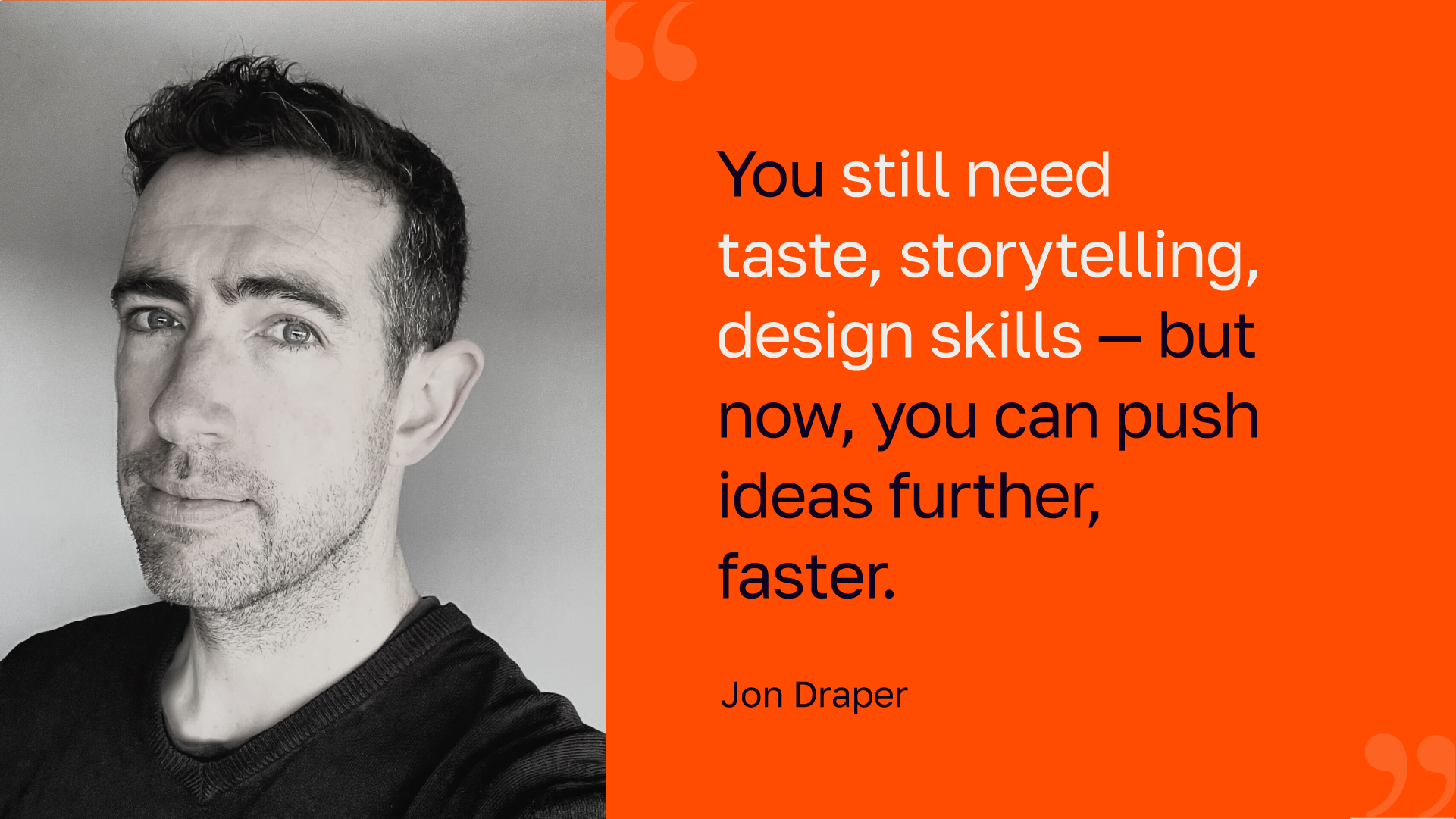
Instead of replacing human input, AI acts like a creative accelerator. You still need taste, storytelling, design skills — but now, you can push ideas further, faster. And often, those rapid iterations can spark new ideas you might never have arrived at using traditional methods alone. That’s where the real magic is: AI as a creative collaborator, not a replacement.
The ethics around generative AI is clearly an area of hot debate. In your view, what ethical considerations should brands keep in mind when using AI?
The big one is, of course, the training data behind the AI models being used — especially for image and video generation. Brands need to be aware of where that data comes from, and how it aligns with their own values and risk tolerance. Depending on where you intend to publish, some mainstream media platforms and broadcasters have bans or strict guidelines around AI-generated content, particularly if it involves models trained on copyrighted or unlicensed material.
It’s essential to think not just about the end result, but the full pipeline — where the models come from, how the assets were created, and how the audience might perceive it. Public pushback around the ethics of AI-generated media is very real, and ignoring it can damage brand trust.
On my own site, aianimation.com, we’ve implemented various AI models for both image and video generation — but we’re actively exploring ways to offer ethical models that can genuinely compete with the current leaders. We’re also expanding into AI-assisted tools that help streamline production workflows without raising the same ethical or training data concerns.
The good news is that we’re starting to see models emerge that are trained on ethically sourced or fully licensed datasets, which will make it easier for brands to adopt these tools responsibly. On top of that, governments and regulators are moving quickly to define what fair usage looks like. It’s still a bit of a minefield — and I wouldn’t claim to be fully qualified to navigate all of it — but it’s something I try to keep tabs on closely, because it’s evolving fast and will absolutely shape how AI is used in production going forward.
Looking forward, what’s next for AI in creative production?
We’re moving quickly from using AI purely for inspiration or rough concepts to fully integrating it into professional production pipelines. The tools are evolving at an incredible pace — not just in terms of quality, but also control, consistency, and how well they now integrate with traditional software. We’re already seeing AI used for shot planning, previs, animation, asset generation, and even full scene compositing.
The next big leap, I believe, will be interoperability — where AI tools slot more seamlessly into established workflows like After Effects, Unreal Engine, or Blender. That’s when mass adoption will really take off, especially for studios trying to deliver more content, faster, and on tighter budgets.
Ethical sourcing and licensing clarity will also play a huge role. As new models are trained on properly licensed or open datasets, brands and broadcasters will become more confident about using AI-generated content at scale. I’m focused on making easy to use tools offering smooth workflows and integrating with other platforms as well as using ethical, high-performance models that enhance production without compromising creative standards or IP integrity.
In recent AI R&D and consulting work with studios, we’ve been combining a wide range of AI tools — including deepfake tech — to explore unique creative possibilities that would’ve been completely out of reach on previous budgets. As these tools mature and workflows consolidate, the need to bounce between 5–10 different platforms to achieve a specific look will fade. At that point, I don’t think we’ll even talk about it as “AI production” anymore — it’ll just be production.
Long term, I think we’ll see more creatives shift from being tool users to tool designers — building custom AI pipelines tailored to their own vision. That’s when things get really exciting: when AI stops being a black box and becomes a co-pilot, shaped by your own creative fingerprint.
Connect With Us
As Jon illustrates, the most powerful applications of AI in production occur when technology amplifies human creativity rather than replacing it. At Synima we transform brand objectives into captivating visual stories, integrating advanced technology with finely tuned creative expertise. Ready to enhance your brand storytelling? Let’s connect.
Head of Marketing at Synima