
Most companies have AI tools by now. Far fewer have changed how they actually work. Adding AI to an existing process can make individual tasks quicker, but the bigger gains come from stepping back and asking how the work would look if it had been designed with AI from day one.
Romano Roth, Group Chief AI Officer at Zühlke, has spent more than two decades at the firm, moving from software engineer through architecture, consulting and leadership. He is the author of The Cybernetic Enterprise, co-hosts the Prompt & Proper podcast and teaches at the Lucerne University of Applied Sciences and Arts.
In our conversation, Roth explains why the biggest AI opportunity lies in redesigning entire processes, and how creative businesses can approach IP and governance while the law is still catching up. He also covers why he expects average content to lose its value fast, and why his first rule for handling uncertainty comes straight from The Hitchhiker’s Guide to the Galaxy.
Romano, where are you seeing the most interesting opportunities for AI in the IT and tech industry right now?
AI in software development is already delivering. Teams write code faster, and even more valuable, they can test an idea, a requirement or an architecture in hours instead of weeks, before anyone commits to building it.
The big opportunity sits one level higher: rethinking entire processes and the way an organisation works. Most companies take an existing process and put AI on top of it. That rarely creates value, because the process was designed around the limits of people and handovers that AI removes. The real value comes when you ask how the work would be designed if AI had been there from the start, and then rebuild the process, the roles and the decision paths around that answer.
How are you personally using AI in your work at the moment? What has it genuinely changed rather than simply made faster?
Since the launch of ChatGPT I’ve been working more and more closely with AI, and I’ve redesigned many of my own processes from the ground up. Because the technology keeps moving, that redesign never finishes. I keep adapting those processes to whatever has become possible.
The latest step is GrokBot. There I now run agents with a real identity: each has its own email address and gets things done for me. One of them works as a podcast assistant for Prompt & Proper, the podcast I host with Steffen Ochsenreither. It prepares and organises the episodes for both of us. It works as if we had a real human podcast assistant.
What it has genuinely changed is my role. I spend less time doing the work and more time deciding what the work should be and checking the result.
How should the industry balance encouraging innovation and protecting IP?
First, be clear about where the law stands, because it differs by country. In the US, copyright requires a human author and a patent requires a human inventor, so work generated entirely by AI is not protected there. The UK still protects computer-generated works, but in March 2026 the government recommended removing that protection. What remains open almost everywhere is how much human contribution is enough. So, if you want protection that holds across markets, make sure a human contributes the essential creative work.
Second, ask whether protection is worth the delay. With AI producing huge volumes of output, infringements become harder to detect and protection harder to enforce. For many products, being first and serving customers well matters more than protecting the implementation. Where the idea has real depth, I think it’s worth exploring whether it can be protected at the level of the specification rather than the implementation, and using human authorship deliberately there.
What should good AI governance look like in the creative industry, and how do you avoid rules that become obsolete?
I come from engineering, not from the creative industry, but the principle that works for us should carry over: govern the environment, not the model. Rules about the model itself age fast, because models change every few months and nobody can look inside them. Rules about how the model is used last much longer.
The second principle is governance by design. Provenance has to be recorded while the work is being made: which parts came from a person, which from a machine, and on what material. Reconstructing that afterwards, when a client or a court asks, is expensive and often impossible.
Is there anything about the current AI conversation that we’re getting completely wrong?
Two things. First, we buy tools and hope the tool will change how a company or a team works. It doesn’t. The Stanford AI Index 2026 shows 88% of organisations using AI, while scaled deployment of AI agents is still in the single digits across nearly all business functions. What’s missing is space and time for people to unlearn old habits, relearn and redesign their processes. That’s where the real magic happens.
Second, the doom scenarios. A lot of that is fearmongering, and it’s also very good marketing for the AI companies. We will not die because of a pattern-matching engine. AI is not evil. What we should worry about is how humans use it.
Looking five years ahead, what will feel completely obvious in hindsight?
That average content became a commodity. Think of the rectangle in a magazine or a LinkedIn post where an image used to sit. Anyone can generate that image today. Honestly, that image never had much value in itself. A really good image still does. The same holds for a great film, a great piece of music or a great photograph. Everything in between is losing its value fast. That’s why I expect more innovation and more experimentation from the creative industry soon, and far more distinctive work than the average AI slop we’re flooded with right now.
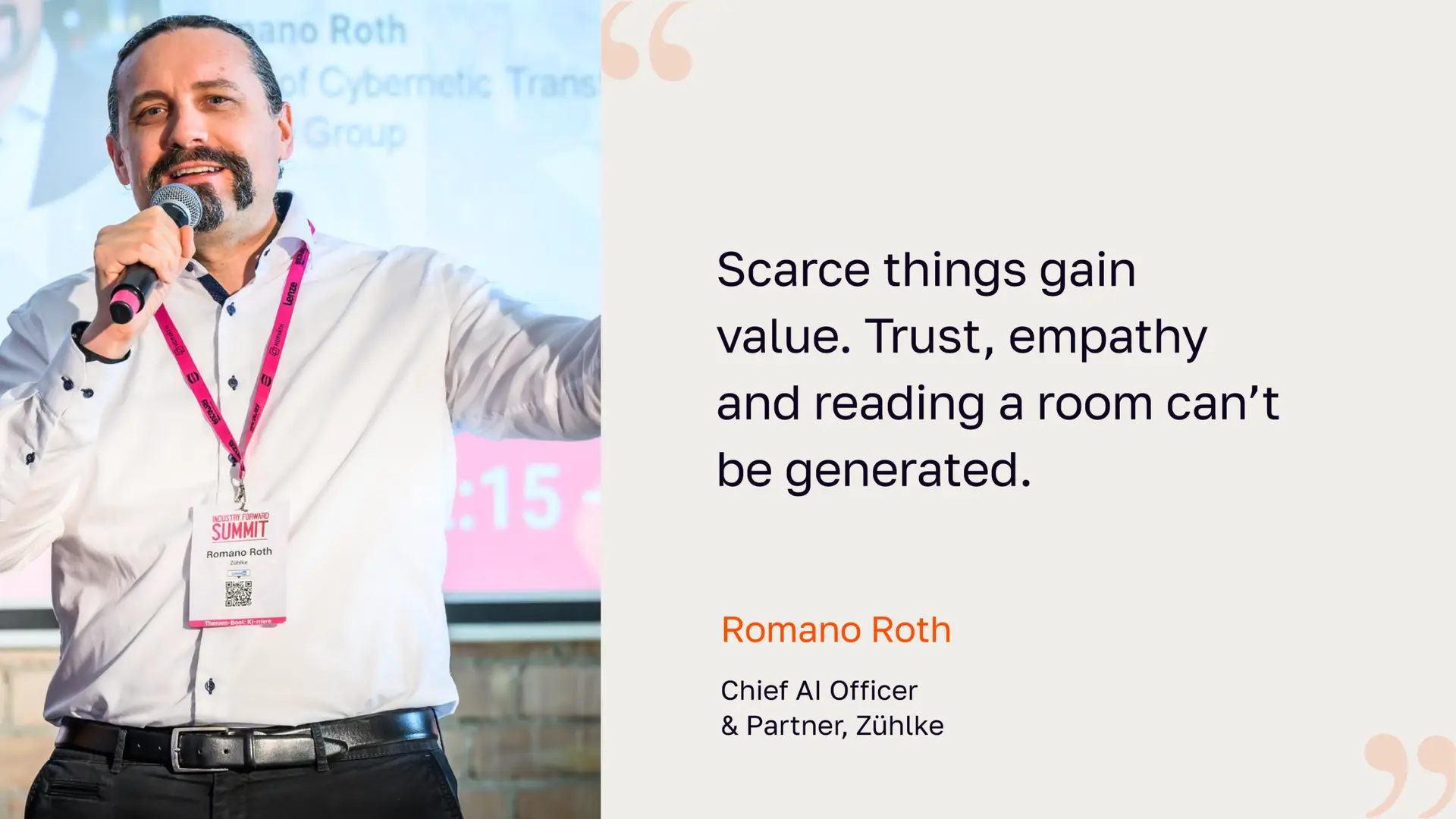
The second thing is how much more human interaction and emotional intelligence matter. The more routine work AI takes over, the scarcer real human contact becomes, and scarce things gain value. Trust, empathy and reading a room can’t be generated. In five years, it will seem obvious that the people and companies who invested in exactly that came out ahead.
Is there a piece of advice, an experience or a mistake from earlier in your career that still influences you today?
I’ve spent more than two decades at Zühlke, starting as a software engineer and moving through architecture, consulting and leadership. The lesson I carry from that path is that the hardest problems are rarely technical. A team can write excellent code and the product still fails, because the problem was framed wrongly, because the next team receives the work weeks later, or because nobody finds out for months whether customers actually use it. Optimising one part rarely helps. You have to look at the whole system and change how the parts work together. DevOps taught me exactly that.
With AI that lesson becomes even more important. Technology is no longer the problem, and writing code is no longer the challenge. The hard part is knowing what you actually want and solving the right problem for the customer. That’s why I’m convinced the skills that matter most now are complex problem solving, whole-system thinking and critical thinking. AI can produce answers in seconds. Whether it’s the right answer to the right problem is still our call.
As the pace of change gets faster, what have you learned about yourself that helps you navigate uncertainty?
First: Don’t Panic. The Hitchhiker’s Guide to the Galaxy got that right, and the answer is 42 anyway. The hard part, as Deep Thought found out, is knowing what the question actually is.
Second, I don’t need to predict the future, I need short feedback loops. When I don’t know what’s going to work, I run a small experiment, look at the result and adjust. That idea is at the core of my book, The Cybernetic Enterprise, and it works for organisations as well as for me personally.
Third, never stop learning. What I knew about AI a year ago is already outdated, and that will stay true. So learning is a daily habit for me. Publishing more than 625 videos and 180 articles and teaching at the Lucerne University of Applied Sciences and Arts forces me to keep up and to work out what I actually think. When the evidence changes, I’d rather update my position openly than defend an old one.
Connect With Us
Roth’s view is a useful reminder that the hardest parts of AI adoption still sit with people. Someone has to frame the right problem, redesign how teams work together, and make work distinctive enough to rise above the flood of average content. At Synima, we pair AI capabilities with human creativity and proven storytelling to help brands make content that earns attention. Ready to rethink how your content gets made? Let’s talk.
Head of Marketing at Synima
