

In our ongoing series exploring the technical and creative decisions behind standout visual moments, we examine how deliberate compositional choices transform storytelling, creating visual harmony that guides viewers through narrative.
The Strategic Framework
Composition isn’t merely about arranging elements in a pleasing manner — it’s a fundamental visual language that shapes how viewers interpret and connect with content. Whether you’re creating animation, live action, or mixed media, mastering compositional techniques provides powerful tools for enhancing storytelling.
Four essential compositional approaches used in effective visual storytelling are:
1. Balanced (Split) Compositions
2. Spiral Section
3. Diagonal Composition
4. Golden Section
Each technique creates different emotional responses and visual flow while serving specific narrative purposes.
Balanced (Split) Compositions
Split compositions divide the frame into distinct areas, creating visual counterweight while establishing relationships between elements. This technique is particularly effective for:
• Showing contrast or duality between characters or concepts
• Creating a sense of order and structure
• Establishing clear visual relationships between elements
• Highlighting similarities or differences within a single frame
Split compositions create immediate visual harmony while establishing clear narrative relationships—in the below example, the character in bed is balanced against the surrounding environment, creating a composition that feels complete despite its asymmetry.

Spiral Section
The spiral section creates dynamic visual movement and guides the viewer’s eye throughout the frame in a deliberate pattern. This technique leverages the natural tendency of our vision to follow curves and creates a sense of depth and dimension.
Key advantages of spiral composition include:
• Creates natural visual flow through the frame
• Establishes dynamic energy even in static scenes
• Guides viewer attention in a specific sequence
• Adds depth and dimensionality to flat animations
The example below shows healthcare professionals in a clinical setting, with the spiral composition creating a natural pathway that connects characters while emphasizing their relationship and the surrounding environment.

Diagonal Composition
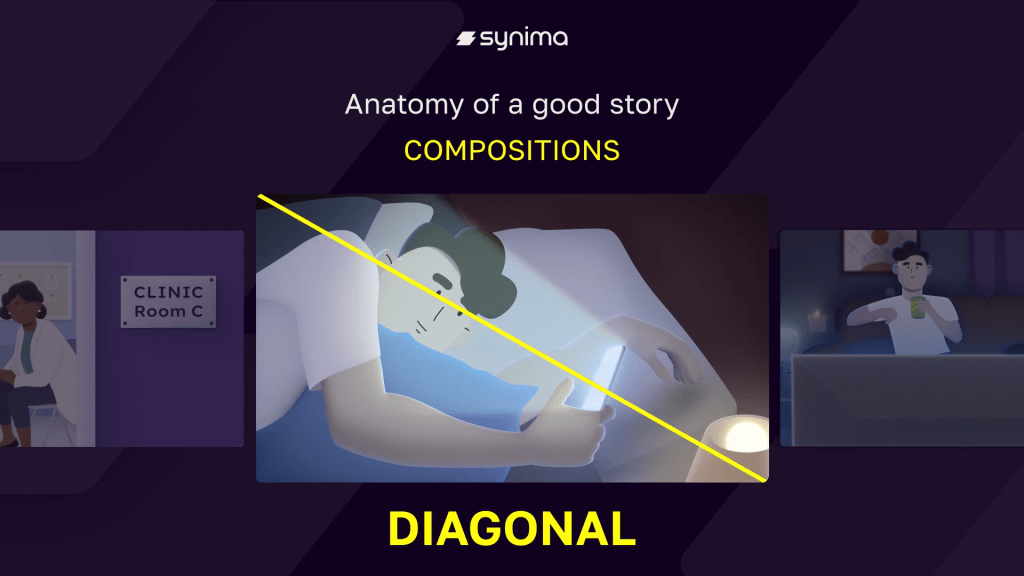
Diagonal compositions introduce energy, tension, and movement. The diagonal line creates an immediate sense of dynamic action that flat horizontal or vertical compositions often lack.
This approach serves several storytelling functions:
• Creates immediate visual energy and movement
• Establishes tension or dynamism
• Breaks the predictability of horizontal/vertical lines
• Directs the viewer’s eye across the frame
In the example below, a character using a phone in bed is composed along a diagonal line, creating visual interest and suggesting movement or flow across the frame.
Golden Section
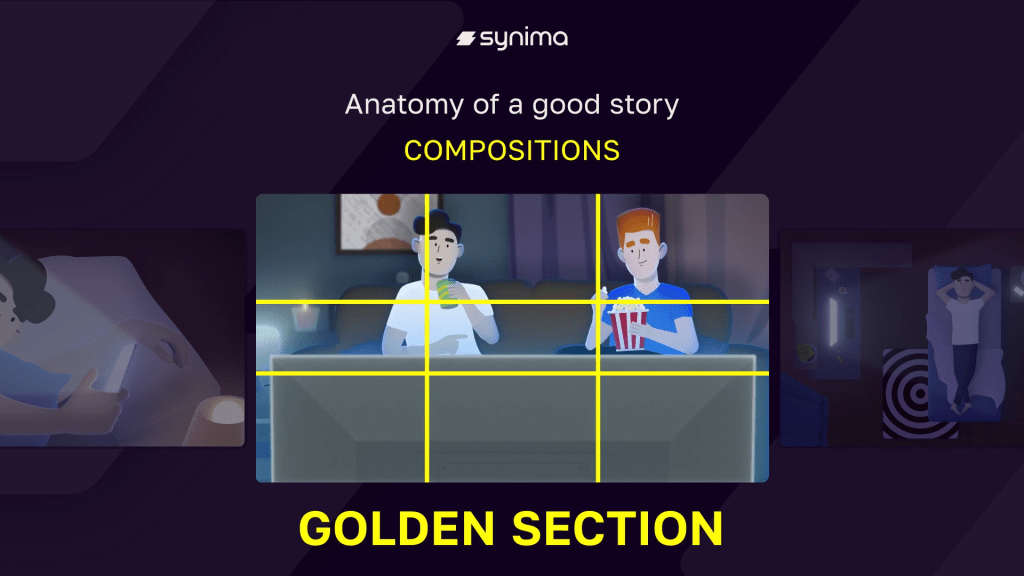
The golden section (also known as the rule of thirds) divides the frame into a 3×3 grid, with key elements placed along these lines or at their intersections.
This compositional approach has been used by artists and filmmakers for centuries because it creates naturally balanced compositions that feel visually satisfying without perfect symmetry.
The golden section offers several storytelling advantages:
• Creates naturally balanced compositions
• Provides clear focus points for essential elements
• Allows for asymmetry that still feels harmonious
• Creates visual rhythm that guides the eye
This example shows two characters watching TV, with key elements positioned along the grid lines, creating a composition that feels natural and balanced while clearly establishing the relationship between the characters.
“Thoughtful composition creates a visual language that supports and enhances storytelling“
The Integrated Approach
While we’ve isolated these techniques for clarity, the most effective visual storytelling often combines multiple compositional approaches, shifting between them as narrative needs evolve.
Thoughtful composition creates a visual language that supports and enhances storytelling. Each composition decision should serve narrative goals, not just visual preferences.
The strategic use of these techniques creates visual consistency while allowing for emotional and narrative variation throughout a piece. This balanced approach ensures viewers remain engaged while subtly guiding their attention to key story elements.
Practical Application
These compositional techniques can be applied across mediums – from animation to live action, social content to feature films. The principles remain consistent even as implementation adapts to specific formats.
For creators looking to strengthen their visual storytelling:
• Begin with narrative intention – what feeling or relationship is this shot meant to convey?
• Consider the natural eye movement each composition creates
• Use compositional techniques consistently to establish visual language
• Vary compositions to create different emotional responses as your story evolves
This intentional approach to composition transforms good visual content into great visual storytelling – where every frame not only looks compelling but actively contributes to narrative understanding.
This article is part of our ongoing “Anatomy of the Shot” series, where we deconstruct the technical and creative processes behind standout visual moments. Sign up for our newsletter for more behind-the-scenes insights into our creative workflow.

Head of Marketing at Synima