

In today’s complex financial landscape, payments systems serve as the essential infrastructure powering global commerce, yet often remain invisible to the very people who rely on them daily. We connected with Ruya Niazi, Head of Marketing for EMEA at J.P. Morgan Payments, to explore how storytelling and human-centered communications transform technical infrastructure into meaningful solutions that resonate across diverse markets. From finding the humanity in data to building influence in large organizations, her insights offer valuable perspective for anyone navigating the intersection of technology and human connection.
How do you make something as foundational as payments feel meaningful to customers and stakeholders?
I once heard someone describe payments as the oxygen behind the global economy — and it stuck with me.
Payments refer to the systems, processes, and technologies that enable the transfer of monetary value, which includes everything from cash, cards, and bank transfers to digital wallets and real-time payments. Payment systems comprise of the institutions, rules, procedures, and technologies that make these exchanges possible — often operating behind the scenes to ensure funds move securely and efficiently.
What keeps me excited every day is there is so much more to learn, especially with the pace of change in payments and technology. With advances like contactless payments, digital wallets, and instant transfers, transactions are faster and are adapting to changing consumer and business needs across the world.
However, it is the connection to real impact, especially as a marketer (and Pisces!) that keeps me inspired — and the work, impact and philanthropic efforts that are achieved through the power of payments. For example, payments power everyday experiences like enabling international trade, supporting families through remittances, and fueling global e-commerce. These stories show payments as the enabler of opportunity and prosperity, not just a technical process. With more visibility than ever before in payments, and faster and more secure transactions, we are helping businesses expand and individuals access funds instantly, even across borders.
It is through the power of storytelling, across all types of marketing channels, such as client case studies, customer journeys, publications, events, and digital content, that we can help share this impact and bridge the knowledge gap on what payments can mean for you and your business; all while building trust and engagement so payments is seen as adding transformative value.
In an industry rooted in data and infrastructure, where do you find opportunities to make messaging more human — and why does that matter?
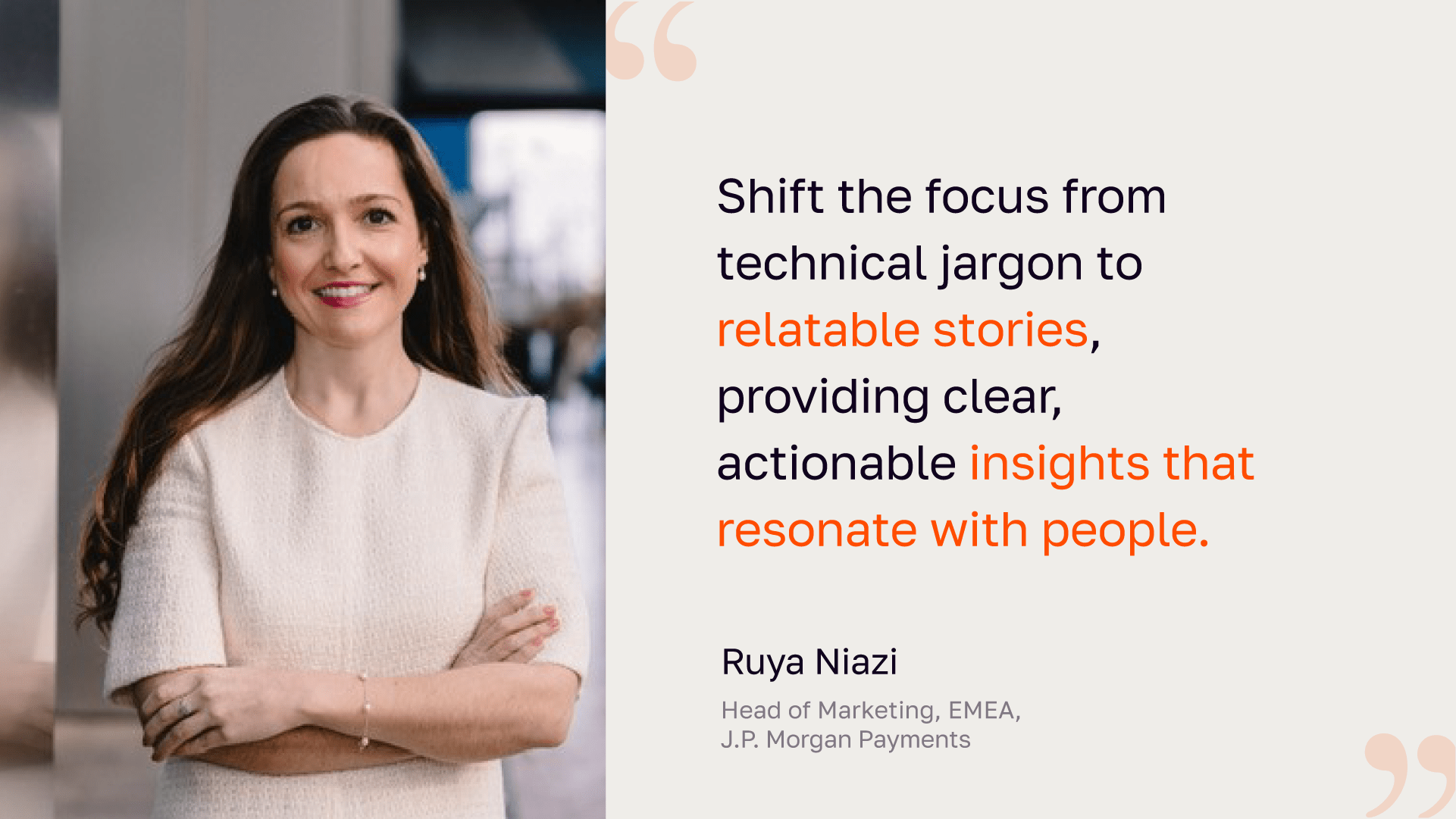
Ultimately, at the heart of every business interaction is a human being seeking connection. The goal should always be to humanize messages, making every interaction meaningful, empathetic, and genuinely impactful. By translating complexity into clarity and infusing empathy, we ensure that every message resonates with its audience — because people, not just data, drive business and global success. This can be activated through a few different ways, such as storytelling through data visualization. By transforming raw data into intuitive visuals and compelling narratives, we make complex information accessible to non-technical audiences. This approach shifts the focus from technical jargon to relatable stories, providing clear, actionable insights that resonate with people.
Personalization is also key, tailoring messages to the recipient’s — whether a client or prospect — specific goals, responsibilities, and context enhances engagement, making interactions more relevant and meaningful. Additionally, in a world of AI, combining AI-driven insights with human empathy ensures that messaging addresses not just what the data says, but why it matters and how it impacts real people. This is crucial for interpreting sentiment, understanding customer pain points, and explaining complex changes.
Through these activations you can build brand trust, and enhance customer experience, as people — even finance decision makers who in many cases are who we talk to day-to-day in payments — seek connection and understanding, not just answers. All of which drive better outcomes for us as a bank, but also increase visibility and understanding for the client or prospect with whom we are speaking. When people truly understand the message, they can make more informed decisions, leading to stronger business performance and loyalty. In my opinion, relying solely on automated or technical messaging can lead to confusion or brand damage if not properly executed.
What role does storytelling play in helping people understand complex solutions in a space like payments — especially across such a diverse region like EMEA?
Storytelling in payments serves as a powerful tool to demystify complex solutions, foster cultural relevance, build trust, highlight benefits, create emotional connections, make opportunities more tangible, and drive adoption across the diverse EMEA region. Importantly, by leveraging the art of storytelling, payments providers can effectively communicate their value propositions and engage audiences in meaningful ways.
What advice would you give to someone entering payments marketing today who wants to build influence inside a large organization?
Building influence in payments marketing within a large complex organization like a bank requires a strategic approach that combines industry expertise with an intrigue to learn, collaborate, and be an effective communicator. Stay ahead of emerging payments trends such as open banking, digital wallets, embedded finance, and AI-driven solutions. Understanding these innovations and their impact on consumers and businesses will position you as a knowledgeable resource within your organization.
Develop strong relationships from day one, hosting those intros and getting comfortable with being outside of your comfort zone to ask lots of questions. Partnerships with product, marketing centers of excellence, sales and compliance teams, as payments organizations increasingly integrate these functions, are all key people to build strong relationships with.
Keep honing in on developing the skill of simplifying the complex so that, as much as possible, everything you work on is clear, and highlights business-relevant benefits for internal stakeholders. Use data and case studies to demonstrate how marketing initiatives drive measurable outcomes in a rapidly evolving landscape, with confidence while being open to change.
Demonstrate adaptability and a willingness to learn new skills and technologies, as payments is a fast-changing field. Be proactive in seeking feedback and iterating on your strategies to stay ahead.
And finally, show leadership and initiative: volunteer for opportunities, or projects, especially those tied to strategic priorities or where you may see someone needs some help. Position yourself as someone who not only understands marketing but always acts with kindness too. Mastering these areas, will enable you to pave the way for effective influence and drive impactful marketing strategies within your organization.
What’s something outside of work that shapes how you lead?
Outside of work, several aspects of my life significantly shape how I lead. On a personal level, my experiences overcoming life’s rocky times, such as losing family members like my nana and my father at a young age, and living in New York City during Covid-19, have been instrumental in developing resilience and empathy, qualities that are essential in leadership. These experiences have taught me the importance of perseverance and understanding, enabling me to connect with my team on a deeper level and support them through their own life challenges as we are all on a journey together.
Spending time with my small family and friends is another crucial influence and being open to new people who enter my life. This time allows me to recharge and maintain a healthy work-life balance, reminding me of the importance of relationships and support systems. It reinforces the value of collaboration and trust, which I strive to cultivate within my professional environment. Additionally, my passion for theatre and dance plays a significant role in shaping my leadership style. The arts teach creativity, discipline, and the ability to express oneself, all of which are vital in leading effectively. Theatre and dance also emphasize the importance of teamwork and communication, skills that are directly transferable to the workplace. They help me approach problems with a creative mindset and encourage my team to think outside the box.
These influences collectively help me maintain perspective, balance, and a sense of responsibility that extends beyond mere business success. They remind me that leadership is not just about achieving goals but also about nurturing a positive and supportive environment where everyone can thrive.
Connect With Us
At Synima, we transform complex concepts into compelling visual narratives that resonate with diverse audiences across global markets. Our approach combines strategic storytelling with advanced visual techniques to make even the most intricate systems feel meaningful and human. Ready to bring your solution to life through powerful video or animation? Let’s connect.

Head of Marketing at Synima