

Effective brand storytelling requires more than clever hooks — it demands genuine understanding of who you’re speaking to and why you have the right to speak. We connected with Indy Selvarajah, Chief Creative Officer at Ketchum, whose unconventional path from gallery artist to TV writer to award-winning creative leader offers unique perspectives on crafting narratives that truly resonate.
Grounded in both creative excellence and strategic thinking, Indy Selvarajah keeps his approach to brand communication simple. And under his leadership, Ketchum London transformed from a creative department of two with no creative awards to one of WARC’s Top 10 creatively awarded agencies in the UK. Selvarajah’s work spans iconic campaigns for brands like Lego, Adobe, and Dove, each demonstrating his philosophy that effective storytelling requires both audience insight and brand authenticity.
From challenging conventional social media wisdom to advocating for narrative structures borrowed from South Park’s creators, Selvarajah’s perspective cuts through industry noise to focus on what actually moves audiences. Our conversation explores how brands can build deeper connections through smarter storytelling choices.
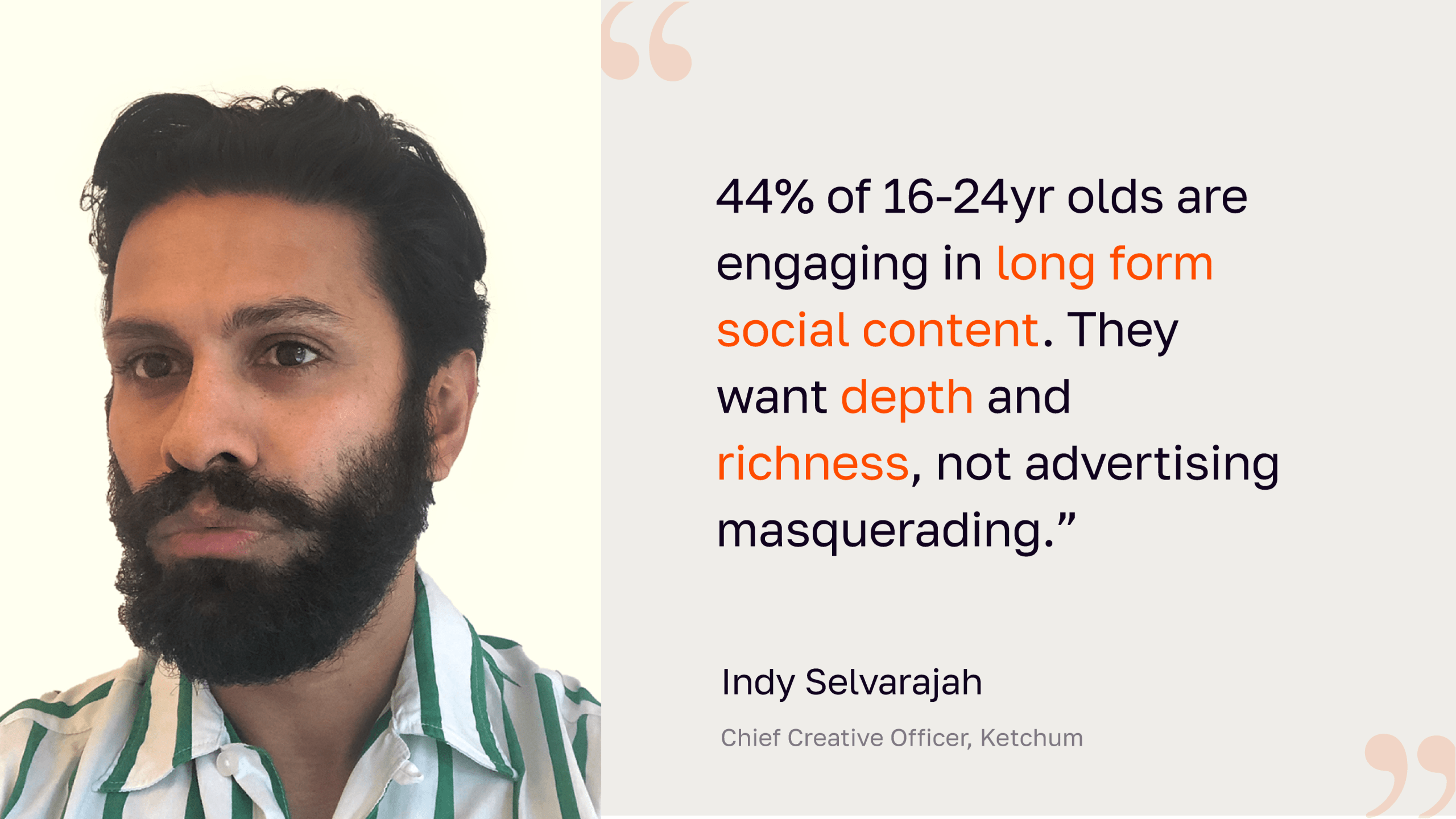
Indy, your work spans multiple creative disciplines — from gallery exhibitions to TV writing to advertising. How do you approach crafting a compelling narrative for a brand?
Two things for me. It has to resonate with your target audience. There are times, rarely, that you can find a universal truth that hits home with everyone, but mostly you must truly know who you are talking to and what their motivations are. And secondly, it has to be a narrative that the brand can legitimately play in and have the right to speak up about in this arena.
What’s an underutilized storytelling technique that more brands should adopt?
I still don’t think brands really utilise the smart and effective construct of storytelling. Matt Stone and Trey Parker talk about it all the time. The ‘but’ and ‘therefore’ rather than the ‘and then’. If everything is ‘and then’ it’s predictable and we aren’t learning anything new. This should be adopted to not just long form but anything you are creating that starts from a written script or narrative.
Our Lego campaign is a good example of ‘but’ and ‘therefore.’
Social media platforms have fundamentally changed content consumption patterns. How has this shift influenced brand storytelling strategies?
We are constantly being told to ‘tell the audience everything in the first 5-8 seconds’, but I disagree with this, especially when we are thinking about younger audiences. They are savvy to this and want to be fed film and visuals that have depth and richness, not just advertising masquerading. In fact, 44% of 16–24-year-olds are now engaging in long form social content, and 48% of 25–34-year-olds. Much higher than it has ever been. Yes, there has to be a hook and way to draw them in, but there are many ways to do this.
We need to start thinking about social in the same way we viewed traditional film or even movies. You need to set the scene, draw people in, give them jeopardy and suspense. And you need time to do this.
What’s one mistake brands make when trying to connect with their audience?
Pretty simple. Know your audience! If it means you are only looking to reach and engage with a small audience, then so be it. Make it worthwhile and effective. The work we do is all about reaching the people who count, not counting the people that we reach.
Our latest Liming with Gran campaign did exactly this. It is super focused and targeted on one audience. And because of this, the results and effectiveness have been super high.
Your career path has been notably unconventional. Looking back, what lessons shaped your approach to creative work?
I had a very different way to get to what I am doing now. Very untraditional journey. Degree in architecture, gallery artist, wrote for tv and film, moved into traditional advertising, and now at a PR agency. So as you can imagine, lots of different disciplines, ways of working, and with very different kinds of people. Which I think is great, and everyone should try and experience as much as possible. Move out of comfort zones whenever you can. I know people who have been at the same agency for 8, 10, 15 years. It’s not healthy in my opinion.
The other point to make is that I’ve never seen things as ‘mistakes.’ It’s a word that’s poison to the mind. I see mistakes as challenges, which works like white magic for me.
Connect With Us
Effective brand storytelling isn’t about following formulas — it’s about understanding your audience and crafting narratives with genuine purpose. At Synima, we believe in the power of authentic storytelling to transform brand connections. Let’s talk.

Head of Marketing at Synima