

In the rapidly evolving world of AI-powered content creation, few practitioners have navigated the spectrum quite like Gabe Michael. From viral internet experiments to award-winning film productions, as an AI filmmaker and creative production executive, Michael has carved out a unique position helping organizations understand not just what’s possible with emerging tools, but how to integrate them meaningfully into existing creative workflows.
Michael’s take on AI filmmaking is reflective of his experience as a seasoned creative executive: rather than positioning these tools as revolutionary replacements for traditional methods, he sees them as the latest evolution in how technology has always shaped storytelling — from the first movie cameras to modern visual effects. His recent work, including competition wins for ‘Best Character’ and ‘Best Art Direction’ at Runway’s Gen:48 AI Film Competition, demonstrates how creative excellence emerges when technical constraints become creative catalysts.
What sets Michael’s perspective apart is his recognition that the strongest AI-driven content is often a result of spontaneous experimentation rather than elaborate strategic planning (don’t miss his viral SimpliSafe doorbell video, which emerged out of a moment of creative curiosity!).
Looking back across your career in communications, what’s the biggest shift you’ve seen in how brands earn attention and what’s surprisingly stayed constant? As an AI filmmaker and creative production executive, what unique challenges have you found that large organizations face when adopting these tools, particularly as compared to small studios or indie creators?
Large organizations naturally move slower. They have to think about risk, brand reputation, legal frameworks, and client expectations before they can even experiment. Every new tool raises questions: Who owns the output? Is the data safe? How does this align with brand values? That kind of due diligence can stall creative momentum.
By contrast, indie creators or small studios can afford to be scrappy. They can test a tool on Monday, post an experiment on Tuesday, and pivot by the end of the week if it doesn’t work. That speed of iteration fuels breakthroughs.
Enterprises, on the other hand, need guardrails, training, and governance in place before deploying anything at scale. The real challenge is finding ways to keep that spirit of experimentation alive inside a structured environment, creating safe “sandboxes” where people can push creative boundaries without breaking compliance or trust.
You’ve worked on everything from viral internet formats to AI-powered short films. What environments tend to spark your most unexpected ideas?
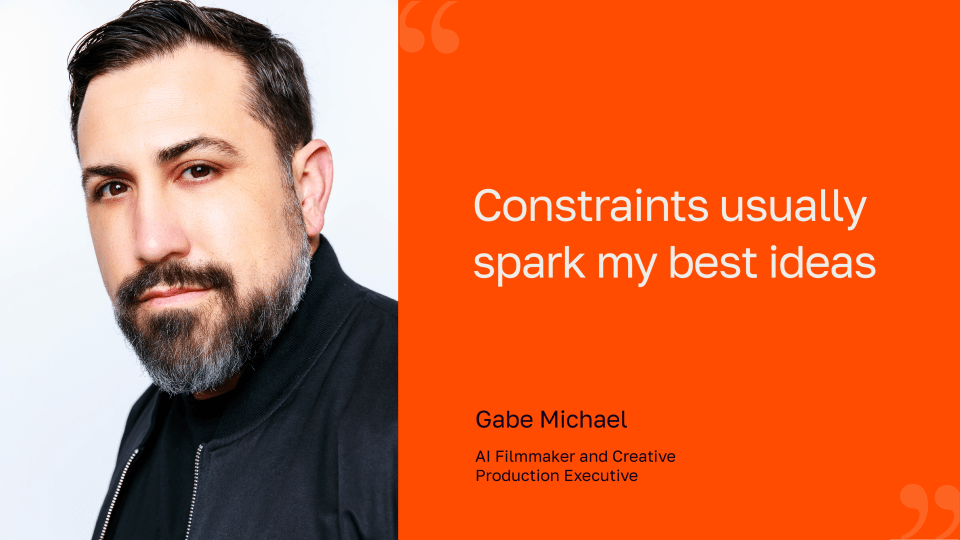
Constraints usually spark my best ideas. Whether it’s a short deadline, a technical limitation, or a strange online format, those boundaries force me to think differently. Instead of being overwhelmed by infinite possibilities, I’m pushed to find creative solutions within tight parameters.
Sometimes it’s the opposite, when there’s no pressure at all and I just follow a random spark. The SimpliSafe doorbell video came out of that. I wasn’t planning it or working off a strategy; I just saw someone on my doorbell camera dropping off a package, though, what if that was an alien, grabbed a screenshot and put it into Veo3. The outcome was great, so I kept going with different characters. That freedom to act quickly without overthinking often leads to the most surprising results.
Your projects often merge storytelling with bleeding-edge tech. What’s your process for making sure the tech serves the narrative, and not the other way around?
I don’t really buy the premise of that question, because technology has always dictated storytelling. From the invention of the movie camera to the rise of visual effects, what’s possible on screen has always shaped the kind of stories we can tell. AI is just the latest version of that, and we are figuring out how to use these tools to tell stories. We are emerging new capabilities along with the models.
For me, the constraints of the technology are part of the creative process. Every tool comes with its limits, and I actually like working inside those boundaries, finding creative ways to push them. They force me to think differently, to find inventive ways to tell a story within what the tech can do right now. So rather than separating narrative and technology, I see them as completely intertwined.
When you’re developing an AI-driven project, what’s the moment in the process that feels most creative to you — aka the spark that keeps you coming back?
The spark comes when the first images or sequences generate and I see a glimpse of what the project could become. That moment of discovery, where something unexpected appears and inspires a new direction. It’s the closest thing to magic in the process.
Is there a moment in your career that completely shifted how you think about creativity and/or production?
The very first edition of Gen:48 completely changed the way I see my workflow going forward (I happened to be one of the winners, BTW). Something just clicked. All my years of experience came together in that moment, and I understood how to use this new form of technology to tell a story.
Since then, I’ve pushed myself to find more innovative ways to use these tools, but that experience was the turning point. What’s remarkable is that there isn’t a day that goes by now where I don’t have the chance to create or experiment with new ideas. That’s something that simply wasn’t possible in the past. Whether the final output is an AI film, a way to workshop ideas for a larger project, or even just the fun of generating an image that has never existed before, it has completely shifted how I think about creativity, storytelling, and production as a whole.
Connect With Us
AI tools are reshaping not just what we create, but how we think about the creative process itself. Michael’s emphasis on constraints as creative catalysts and the value of rapid experimentation offers practical insights for organizations looking to meaningfully integrate these tools. At Synima, we help brands navigate this evolving landscape, combining AI capabilities with proven storytelling techniques to create content that resonates. Ready to explore how these tools can enhance your creative workflow? Let’s connect.
Head of Marketing at Synima